Home > Blog > How to Read a Builders Quote: Your Lancashire Guide
Picture this: you’re planning a dream extension for your home in and around Lancashire and have three builder quotes in hand. One is suspiciously cheap, another is dauntingly high, and the third is just a single, unexplained number on a piece of paper. Choosing the right one feels like a gamble, and the wrong choice could lead to spiralling costs, frustrating delays, and stressful on-site disputes that sour your entire project.
The core problem is that a vague or poorly detailed quote leaves you, the homeowner, financially exposed. It’s impossible to compare offers accurately, and it creates ambiguity that can easily lead to misunderstandings down the line. To make an informed decision and protect your investment, you need to know how to read a builder’s quote with a critical eye. This guide provides the tools to decode complex quotes, identify common red flags, and ensure you’re comparing apples with apples.
In this article, you’ll learn:
- The essential components of a professional, itemised quote.
- How to spot vague descriptions and lump-sum red flags.
- A step-by-step method to compare builder quotes like-for-like.
- A detailed breakdown of hidden costs and common omissions.
What Should a Professional Builder's Quote Include?
A professional builder's quote should be a detailed, itemised document that includes a full breakdown of costs, a clear scope of work, payment terms, and provisional project timelines. It functions as the foundational blueprint for the project, providing clarity and accountability for both you and the contractor, rather than just being a simple price tag. A comprehensive quote demonstrates a builder's professionalism and attention to detail before any work even begins.
A Clear Scope of Work
This is arguably the most critical section. It should precisely detail every task the builder will perform. Just as important, it should also specify what is excluded. For example, does the quote for a kitchen renovation include decorating after the units are fitted? Does the price for an extension include final floor finishes or just the subfloor? Clarity here prevents future arguments over what was or wasn't part of the original agreement.
An Itemised Cost Breakdown
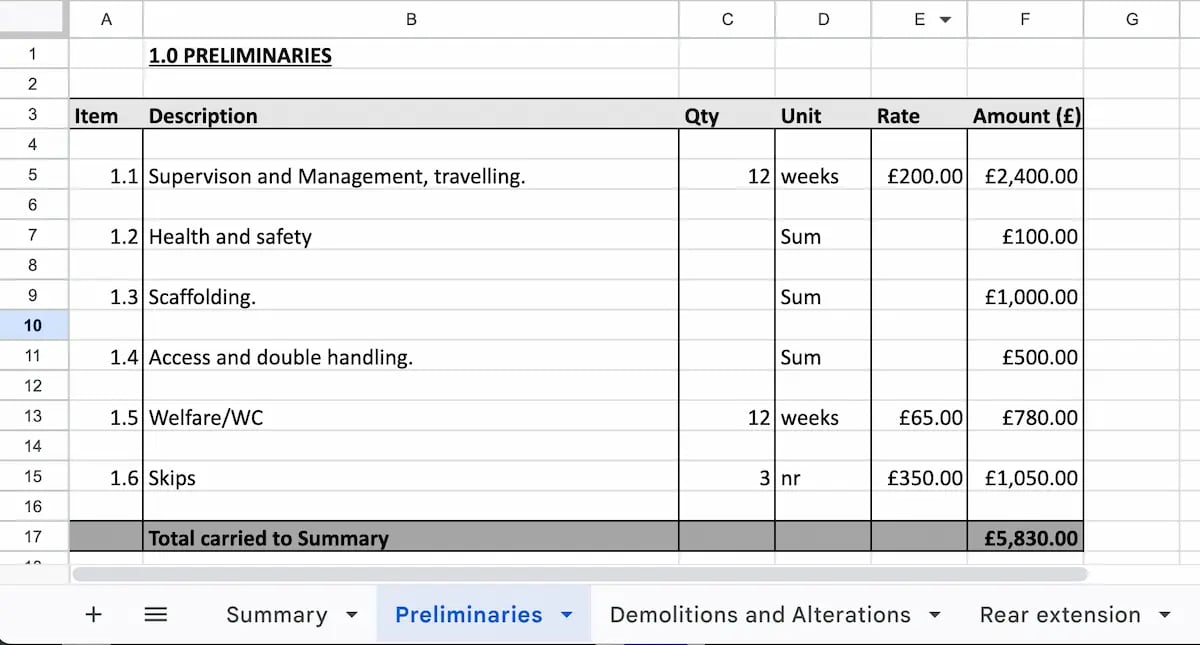
An itemised building quote is non-negotiable. It should break down the total cost into logical components, giving you a clear view of where your money is going. Key items to look for include:
- Labour: How many workers, for how long, and at what rate?
- Materials: A list of key materials with quantities and costs.
- Plant & Tool Hire: Costs for hiring necessary equipment like diggers or cement mixers.
- Waste Removal: The cost and number of skips required.
- Scaffolding: The price for supply, erection, and rental duration.
- Subcontractors: Costs for specialised trades like electricians or plumbers.

Company Details and Legal Information
A legitimate quote will always include the builder’s full business details. This includes their registered company name and address, contact information, company registration number, and VAT number. It should also reference their public liability insurance, giving you peace of mind that they are a professional and accountable operation.
🚩 Red Flag #1: Vague Descriptions and Lump Sums
The single biggest red flag on any quote is a lack of detail. A single "lump sum" figure for a significant project is a sign of either laziness or an intention to hide costs. Without a breakdown, you have no way to verify if the price is fair, compare it to other offers, or negotiate on specific elements. It ties your hands and puts the builder in complete control of the finances.
The Danger of a Single Price
A quote that simply says “Extension as per plans: £75,000” is unacceptable. If you decide to downgrade the bi-fold doors to French doors to save money, how can you be sure the builder is crediting you a fair amount? Conversely, if unforeseen ground issues arise, how can you validate the extra costs they propose? An itemised structure protects both parties from disputes over variations.
Ambiguous Material Specifications
Look out for vague terms like “high-quality fittings” or “standard white sockets.” This ambiguity allows a builder to install the cheapest available option to maximise their profit. A professional quote will be specific.
- Vague: “Supply and fit internal oak doors.”
- Specific: “Supply and fit 5 x Howdens Dordogne Oak internal doors (826mm) with chrome lever handles (£140 per door).”
This level of detail ensures you get the quality you’re paying for.
Unspecified Labour Costs
Labour is often the largest component of a building project. The Federation of Master Builders (FMB) Q1 2024 State of Trade Survey noted persistent skills shortages, particularly for carpenters and bricklayers, which continues to put pressure on labour costs. Your quote must be transparent about this. It should clarify whether the labour is a fixed cost for the entire project or a day rate. If it's a day rate, you need an estimate of the total days required to avoid the budget spiralling out of control.
How to Compare Builder Quotes Like for Like
To accurately compare builder quotes, you must create a standardised framework to analyse them side-by-side. The best method is to use a simple spreadsheet. This process transforms confusing, differently formatted documents into a clear, apples-with-apples comparison, instantly highlighting discrepancies and missing items.
Creating Your Comparison Spreadsheet
Open a spreadsheet and list every single element of your project down the first column. In the subsequent columns, enter the name of each builder who has quoted. Now, go through each quote and fill in the corresponding cells with the price they have allocated for that task.
Your rows should include everything, such as:
- Preliminaries (Site setup, insurance)
- Groundworks & Foundations
- Structural Work (Steel beams, blockwork)
- Roofing & Coverings
- Windows & Doors
- First-Fix Electrics & Plumbing
- Plastering & Dry-Lining
- Second-Fix & Joinery
- Decorating
- Waste Removal & Skip Hire
- Scaffolding
Analysing the Differences
Once your spreadsheet is complete, the differences will be stark. You might find that Builder A’s quote is £5,000 cheaper because they haven’t included scaffolding. Builder B might seem expensive until you see that they have allocated a much more realistic sum for high-quality kitchen materials. This analysis allows you to ask targeted questions: “Your quote doesn’t seem to include skip hire. Is that an additional cost?”
Don't Just Focus on the Bottom Line
The cheapest quote is often the most expensive in the long run. An unusually low price can be a serious building quote red flag 🚩. It can indicate a builder who is desperate for work, plans to cut corners on materials, or will hit you with significant "extras" once the project has started. A well-priced, detailed quote from a reputable local builder in Lancashire is always a safer bet.
Deconstructing the Costs: Labour, Materials, and Prelims
Every building quote is fundamentally composed of three core cost categories: preliminary costs (prelims), materials, and labour. Understanding what goes into each one helps you appreciate the total price and identify where costs are being allocated. A transparent builder will have no issue breaking these down for you, further reinforcing their professionalism.
Preliminary Costs (Prelims)
Prelims are the essential overheads required to run the building site safely and efficiently. They are not direct construction costs but are vital for the project's success. Think of them as the project's fixed running costs. They often account for 10-20% of the total project cost.
Common prelims include:
- Site Management: The project manager or foreman’s time is overseeing the job.
- Insurance: Public liability and contract works insurance.
- Site Setup: Fencing, security, and setting up temporary services.
- Welfare Facilities: Hiring a portable toilet and providing running water.
- Health & Safety: Provision of PPE, safety inspections, and documentation.

Material Costs and Allowances
This section should detail the materials needed for the job. Due to price volatility, most quotes will state that the material prices are valid for a limited period, typically 30 days. For items you haven't chosen yet (like tiles or flooring), the builder will include a 'PC Sum' (Prime Cost Sum), which is an allowance. Ensure this allowance is realistic. An allowance of £20/m² for floor tiles when your preferred option costs £50/m² will create an immediate budget shortfall.
Labour Rates vs. Fixed Price
This is a crucial distinction. A fixed price for labour offers budget certainty, as the builder absorbs the risk of the work taking longer than expected. A day rate offers more flexibility but carries the risk of costs escalating if the project overruns. For a clearly defined project like an extension, a fixed price is generally preferable. A good quote should specify the composition of the team (e.g., 1x site foreman, 2x skilled labourers) and the estimated duration of their work.
Why Are Provisional Sums and Contingencies So Important?
Provisional Sums (PS) are allocated budget amounts for specific work that cannot be precisely priced at the time of quoting, while a contingency fund is your private financial safety net for completely unexpected issues. Understanding the function of both is crucial for maintaining control over your project budget and preventing financial shocks midway through the build.
Understanding Provisional Sums
A Provisional Sum is a placeholder in the quote. It’s typically used when a homeowner hasn't made a final decision on a finish or fitting. For example, a quote might include a PS of £8,000 for the supply of kitchen cabinetry and worktops. If you end up choosing a kitchen that costs £10,000, you will need to pay the additional £2,000. If your choice costs £7,000, you should receive a £1,000 credit. Always ask for these sums to be realistic to avoid them becoming a hidden source of extra costs.
The Non-Negotiable Contingency Fund
Crucially, a contingency fund is your money, held separately from the builder's contract sum. It is not an invitation for the builder to spend more. For renovation projects, especially on older properties in areas like the Ribble Valley, a contingency of 15-20% of the total project cost is highly recommended. This fund covers genuinely unforeseeable problems, such as discovering rotten timber floor joists once a ceiling is removed or finding asbestos that requires specialist removal.
What Happens When Things Change?
Changes are inevitable in any build. A professional quote should be accompanied by terms that outline the process for 'Variation Orders.' This is a formal document that describes the change, details the additional cost (or saving), and must be signed by you before the extra work commences. This prevents disputes over verbal agreements and ensures all changes are tracked and budgeted for.
The "Hidden" Costs: Scaffolding, Waste Removal, and VAT
Some of the most common budget blowouts come from items that are omitted from a cheap or rushed quote. These are often significant expenses that homeowners assume are included as standard. When reviewing a quote, you must actively check for the inclusion of scaffolding, waste management, and VAT, as their absence can add thousands of pounds to your final bill.
Scaffolding: A Major Expense
For any work at height, such as a loft conversion or re-roofing, scaffolding is a legal and practical necessity. The cost is significant. For a standard semi-detached house in Lancashire, a full scaffold structure can cost anywhere from £2,000 to £5,000+ or more, depending on the complexity and rental duration. A quote must explicitly state that scaffolding is included, for how long it will be on site, and whether it covers any specific requirements like temporary roofing.
Waste Removal and Skip Hire
A building project generates a vast amount of waste. A single 8-yard builder's skip can cost between £250-£350, and a typical extension may require multiple skips throughout the project. Your quote must clarify who is responsible for waste disposal. Phrases to look for are “Includes all waste removal from site” or “Includes hire of 4 x 8-yard skips.” If this is missing, you could be left with a large, unexpected bill for skip hire and disposal fees.
The VAT Question
This is a simple but critical point. Is the builder VAT registered? If they are, their quote must clearly show the sub-total, the VAT at 20%, and the final total. A quote that seems 20% cheaper than all the others may have simply omitted the VAT. If a builder's turnover is below the VAT threshold (£90,000 as of April 2024), they won't charge VAT, which can represent a genuine saving. However, the quote must explicitly state this with a phrase like “VAT not applicable.” Never assume, always clarify.
Your Ultimate Construction Quote Checklist
Before you sign any contract, use this final construction quote checklist to ensure you have covered all the bases. A builder who has provided all this information without being prompted is likely to be organised, transparent, and professional. If a quote is missing several of these elements, you should be cautious and ask for the missing details in writing.
The 11-Point Quote Review:
- Full Company Details: Does the quote include a registered address, company number, and VAT number?
- Fully Itemised Breakdown: Is the work broken down into logical stages (e.g., groundworks, roofing) instead of a single lump sum?
- Clear Scope of Work: Are both inclusions and, crucially, exclusions clearly listed?
- Specific Material Specifications: Are product names, brands, or models specified instead of vague terms?
- Labour Costs Clarified: Is it a fixed price or a day rate? If a day rate, is there an estimated duration?
- Preliminaries Included: Are costs for site management, insurance, and welfare facilities itemised?
- Provisional Sums are Realistic: Are the allowances for items like kitchens and bathrooms sensible for your desired quality?
- Payment Schedule is Clear: Are payments linked to project milestones (e.g., 'watertight shell') rather than arbitrary dates?
- Scaffolding & Waste Removal are Included: Does the quote explicitly state these are part of the price?
- VAT Status is Unambiguous: Is VAT shown clearly as included, excluded, or not applicable?
- Contract Terms are Attached: Does the quote reference a standard contract (e.g., FMB or JCT) that outlines dispute resolution and other key terms?
How to Politely Ask for More Detail
If a quote is lacking detail, don’t be afraid to ask for clarification. A good builder will be happy to provide it. You can use phrases like:
- “Thank you for the quote. To help us compare it fairly with others, could you please provide a more detailed breakdown of the costs?”
- “Could you please confirm if skip hire and all waste removal are included in this price?”
Conclusion: Your Quote is Your Project's Foundation
A builder's quote is more than just a price; it's the foundation upon which your entire project is built. Learning how to read a builder’s quote thoroughly is the most important step you can take to ensure your project in Clitheroe or across Lancashire runs smoothly, on budget, and without unnecessary stress. A detailed, transparent, and comprehensive quote protects both you and your builder, setting clear expectations and creating a partnership based on trust.
Key Takeaways:
- Detail is your best defence. Always insist on a fully itemised building quote. Reject any vague, lump-sum offers, as they leave you financially vulnerable and unable to track costs effectively.
- Compare apples with apples. Use a spreadsheet to methodically compare quotes line by line. This will instantly reveal any omissions or significant price differences in cheaper quotes that might signal hidden costs later.
- Budget for the unknown. A personal contingency fund of 15-20% is not optional; it is an essential part of responsible project budgeting, especially for renovations on older Lancashire properties.
- Check for the common omissions. Scrutinise every quote to ensure major costs like scaffolding, waste removal, and VAT are explicitly included. These items can add thousands to the final bill if overlooked.
If you are ready for a transparent, fully itemised, and professionally prepared quote for your next home improvement project, we are here to help. Contact D Blackburn Contractors today to arrange a no-obligation site visit for your home in Clitheroe, the Ribble Valley, or across Lancashire.