Home > Blog > 4 Essential Free Resources for Lancashire Homeowners
Planning a building project is exciting. Whether you're dreaming of a new kitchen extension in Clitheroe, converting your loft in Whalley, or renovating a property in Longridge, there's a real buzz that comes with imagining the finished result.
But between the excitement and the finished build, there's a stretch of planning, decision-making, and preparation that can feel overwhelming, especially if it's your first project.
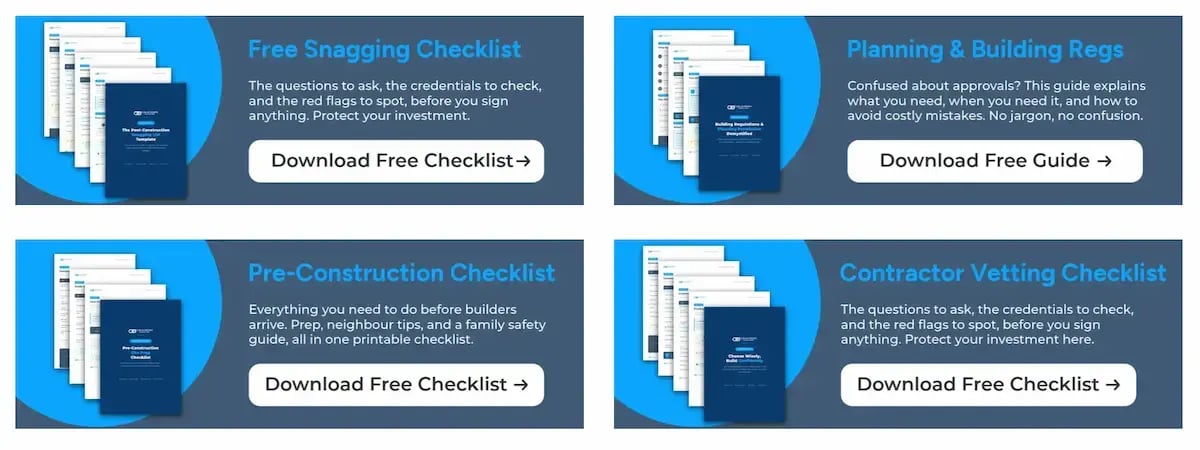
That's why we've put together four completely free resources designed to help homeowners across Lancashire navigate the most important stages of any construction project. No sign-up fees, no sales pitch, just genuinely useful tools you can download, print, and use straight away.
Let's walk through each one and how it can help you.
1. Building Regulations and Planning Permission, Demystified
Best for: Homeowners in the early planning stages who aren't sure what approvals they need.
If you've ever typed "do I need planning permission for an extension?" into Google at 11pm, you're not alone. It's one of the most common questions we hear from homeowners across Clitheroe, Blackburn, Burnley, Preston, and the wider Lancashire area, and the answer is rarely as straightforward as people hope.
The truth is, planning permission and building regulations are two separate things, and most homeowners mix them up. Some projects need one, some need both, and some need neither. Getting it wrong can mean costly delays, enforcement notices, or problems when you come to sell your property.
Our free guide breaks it all down in plain English. No legal jargon, no confusing council-speak, just a clear explanation of what each approval covers, a self-assessment checklist to help you work out what applies to your project, and a step-by-step walkthrough of the application process.
It also covers permitted development rights, which is the set of rules that lets you carry out certain types of work without needing full planning permission. This is where many homeowners in Lancashire can save time and money, but only if they understand the limits. Our guide explains those limits clearly, including the common exceptions that catch people out.
Whether you're considering a rear extension, a garage conversion, or something more ambitious, this guide gives you the knowledge to have an informed conversation with your contractor and your local planning authority, rather than going in blind.

2. The Contractor Vetting Checklist. Choose Wisely, Build Confidently
Best for: Homeowners who are comparing contractors and want to make the right choice.
Choosing the right contractor is one of the single biggest decisions you'll make in any building project. A good contractor delivers on time, communicates clearly, and produces work you're proud of. The wrong one can leave you stressed, out of pocket, and dealing with unfinished or substandard work.
The challenge is that most homeowners don't know what questions to ask. A professional-looking website and a competitive quote might look reassuring, but they don't tell you much about what it's actually like to work with someone.
That's why we created this free vetting checklist. It covers the areas that experienced project managers and property developers check as standard, credentials and accreditations, insurance verification, communication style, pricing transparency, contract terms, and the red flags that should make you think twice.
We'll be upfront about something: yes, we're a contractor giving you a tool to evaluate contractors. We do this because we're confident in our accreditations (Federation of Master Builders, TrustMark, CHAS), our 30+ in-house team, and our track record of over 3,800 completed projects across Lancashire. We genuinely encourage you to use this checklist on us, and on everyone else you're considering.
Here are a few of the things the checklist will prompt you to check:
- Are their accreditations current and verifiable? Anyone can put a logo on a website, always check directly with the accrediting body.
- Do they have adequate insurance? You need to see certificates, not just hear promises. Public liability, employer's liability, and professional indemnity should all be in place.
- How do they handle communication? Pay attention to how responsive and transparent they are during the quoting process, it's usually a good indicator of what they'll be like during the build.
- What does their contract look like? A proper contract protects both sides. If someone is reluctant to put things in writing, that's a warning sign.
This resource is particularly useful if you're managing a project for the first time and want a structured way to compare your options fairly.

3. The Pre-Construction Site Prep Checklist
Best for: Homeowners with a confirmed project and a start date approaching.
You've chosen your contractor, the plans are signed off, and you've got a start date in the diary. Exciting times. But have you thought about what you need to do before the team arrives?
A little preparation on your side makes a genuine difference to how smoothly the first few days go, and it's something many homeowners don't think about until the night before.
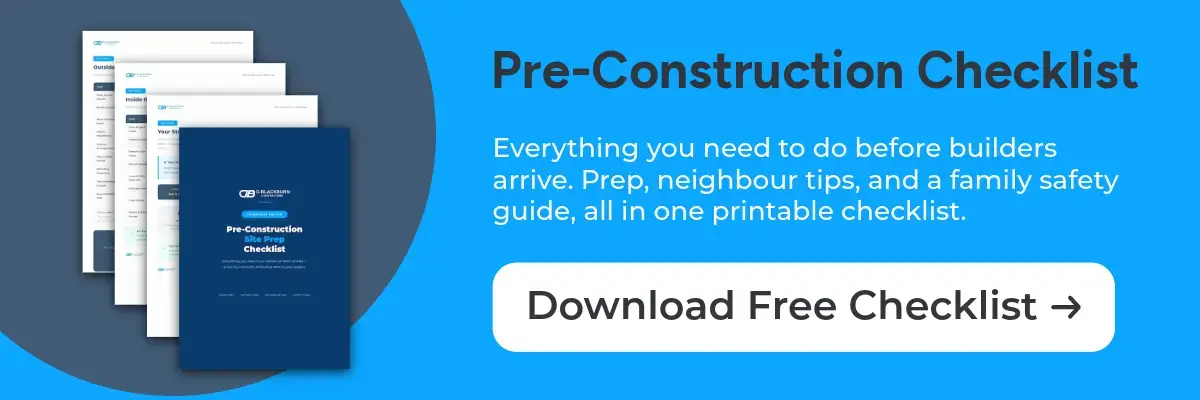
Our free Pre-Construction Site Prep Checklist walks you through everything you need to do in the days leading up to your project starting. It's the same guidance we send to our own clients before every build, refined over thousands of projects across Clitheroe and the surrounding area.
The checklist covers four key areas:
-
Inside the home: which rooms need clearing, how to protect furniture and belongings, where to store valuables, and how to make sure our team can access the areas they need without obstruction. It also covers locating your utility shut-offs (stopcock, consumer unit, gas meter), which is something we'll need you to know on day one.
-
Outside the property: clearing access routes for materials and equipment, protecting driveways and lawns, moving garden furniture and play equipment, and making sure there's space for a skip or waste collection if needed. If your property has narrow lanes or limited parking, common in Clitheroe, Whalley, and many Lancashire villages, this section helps you plan ahead.
-
Neighbours: letting the people around you know what's happening, when it's happening, and how long it's likely to last. A quick knock on the door goes a surprisingly long way. The checklist gives you a framework for what to mention, and our experience is that neighbours who've been kept informed are almost always understanding.
-
Family and pet safety: practical steps to keep children and animals safe during construction. Building sites and curious toddlers don't mix, so this section covers how to establish safe zones and clear boundaries.
Most of the tasks take 30 minutes to an hour, and we'd recommend working through the list five to seven days before your project begins. It saves time, reduces stress, and means our team can hit the ground running from day one.
4. The Post-Construction Snagging List Template
Best for: Homeowners whose project is nearing completion or has just finished.
Your project is almost done, the builders are packing up, the dust is settling, and your new space is taking shape. This is the moment where many homeowners breathe a sigh of relief and assume everything is finished.
But before you sign off, it's worth taking a careful, methodical look at every detail. That's what a "snagging list" is for.
A snag is a minor defect or imperfection, a small paint drip, a door that catches slightly, a socket plate that isn't quite flush, a grout line that's not fully filled. Individually they're small things. Collectively, they're the difference between a project that feels "done" and one that feels "finished to a high standard."
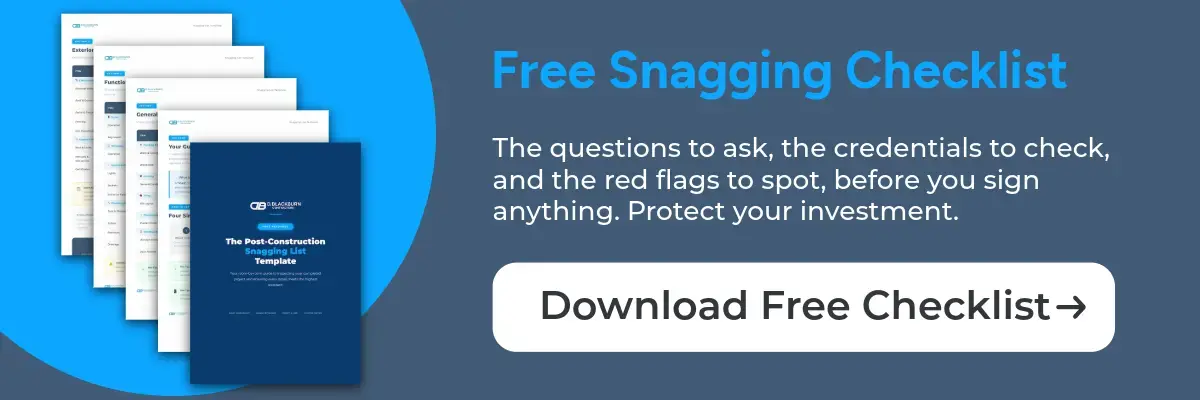
Our free Snagging List Template gives you a structured, room-by-room approach to inspecting your completed project. It's the same methodology our own project managers use when conducting final inspections, and we've refined it over 25 years and more than 3,800 completed builds across Lancashire.
The template covers three main areas:
-
General finishes and aesthetics: painting, flooring, tiling, plasterwork, window frames, and door frames. This is where you're checking that everything looks right: consistent colours, smooth surfaces, clean edges, no chips or scratches.
-
Functionality and structural: doors that open and close smoothly, windows that lock properly, lights and sockets that work, taps and showers with good water pressure, radiators that heat up evenly, and drainage that flows freely. This section is about making sure everything performs as it should.
-
Exteriors and paperwork: external walls, roofing, gutters, paths, patios, fencing, and the essential certificates you need to collect (Electrical Installation Certificate, Gas Safe Certificate, Building Control Completion Certificate). These certificates are vital for insurance and future property sales, and this checklist makes sure you don't overlook them.
The template includes a notes column for recording issues and space for photo references. We'd recommend printing it out and walking through your project during daylight hours, natural light makes surface imperfections much easier to spot. Bring a torch too, for darker areas. And don't rush it. A thorough snag typically takes one to two hours for a standard extension or renovation.
Once your list is complete, share it with your project manager. At D Blackburn Contractors, we work through every snag our clients identify and make sure everything is resolved before final handover.
Why We Created These Resources
We've been building, renovating, and transforming properties across Clitheroe and Lancashire for over 25 years. In that time, we've completed more than 3,800 projects, from single-room renovations to full commercial builds, and the one thing we've learned is that the best projects start with informed, confident clients.
These four resources cover the stages where homeowners typically have the most questions and the least guidance. We wanted to create something genuinely useful, not gated behind a hard sell, not stuffed with marketing fluff, but practical tools you can actually use.
Whether you end up working with us or not, we want your project to go well. That's good for homeowners, good for the industry, and good for Lancashire.
Frequently Asked Questions
Are these resources really free? Yes, completely free. You'll need to enter your name and email address so we can send you the download, but there's no obligation, no automatic sign-up to anything, and no sales call. We might send you a follow-up email with some extra tips, but you can unsubscribe at any time.
Can I use these checklists for any building project? Absolutely. While they've been written with Lancashire homeowners in mind, the principles apply to any residential building project in the UK. The planning permission guide references the general framework that applies across England, though specific local policies may vary by council area.
Do I need all four resources? It depends on where you are in your project. If you're in the early research phase, start with the Planning Permission Guide and the Contractor Vetting Checklist. If you've already got a contractor and a start date, the Site Prep Checklist is your next step. And when your project is nearing completion, the Snagging List Template will help you do a thorough final inspection.
I'm based in Clitheroe, can D Blackburn Contractors help with my project? We'd love to. We're based in Clitheroe and work across a 30-mile radius covering Whalley, Longridge, Blackburn, Burnley, Preston, Accrington, and the wider Ribble Valley area. We offer free, no-obligation site surveys, just give us a call here.
What qualifications and accreditations does D Blackburn Contractors hold? We're proud members of the Federation of Master Builders, TrustMark accredited, and CHAS certified. Our team of 30+ professionals all hold valid CSCS cards, and we carry comprehensive public liability and employer's liability insurance. We encourage you to verify our accreditations directly, that's exactly the kind of due diligence our Contractor Vetting Checklist recommends.
Can I print the checklists and use them on-site? Yes, they're specifically designed to be printed on A4 paper and used with a pen. The snagging list and site prep checklist both include tick boxes and notes columns so you can work through them room by room or task by task.
What if I have questions about my specific project? We're always happy to chat. Whether it's a question about planning permission, a concern about your build, or just wanting a second opinion, you can call us on 01200 469 360 or drop us an email here. There's no charge for an initial conversation, and we'll always give you an honest answer, even if it's not what you were hoping to hear.
Ready to Get Started?
Download whichever resources are most relevant to you right now, and keep the others bookmarked for when you need them. Every building project has its moments of uncertainty, these guides are designed to give you clarity and confidence at the stages that matter most.
And if you're planning a project in Clitheroe or anywhere across Lancashire, we'd genuinely love to hear about it. Our team offers free, no-obligation site surveys where we'll visit your property, discuss your ideas, and give you an honest assessment of what's involved.